That evening, the house exuded luxury like a second skin.
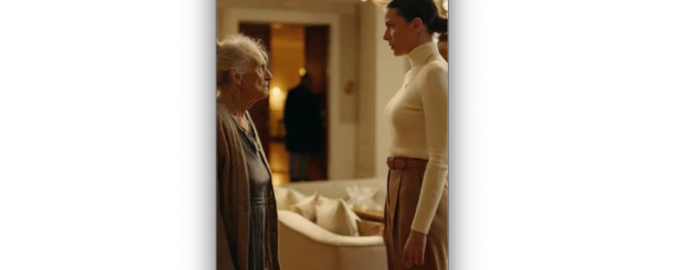
The warm light glided across the pale walls, the polished wood, the expensive fabrics. Everything seemed clean, calm, perfectly in its place… except for one presence that disturbed the order of the setting: a frail old woman standing in the middle of the living room, as if the modern world had placed her there by mistake.
She looked as if she had come from another time.
Her coat was simple, worn by the seasons. Her hands trembled slightly, not only from age, but as if an invisible chill still coursed through her bones. Her back remained hunched, her shoulders too heavy for her, and her face… her face bore a weariness that came not from sleep, but from life itself.
Opposite her stood the wife.
Impeccable. Upright. Elegant. Her voice low, icy, without a single crack. No shouts. No outbursts. Only words perfectly chosen to wound without leaving a trace.
— “Leave this house.”
— “You’re a nuisance.”
— “Your son and I want to live without you.”
— “Go… disappear from our lives.”
Each sentence fell like a door slamming shut.
The old woman didn’t reply.
Her lips barely trembled, as if searching for a word she was no longer allowed to utter. In her eyes, pain rose slowly, silently… then the water glistened. Tears. Not those of a scene, but those of a soul that understands it is being erased.
The living room, though vast, suddenly seemed too small to contain this unease. The silence thickened. One could almost hear the distant sounds of the city, very far away, like a cruel reminder: outside, life goes on, indifferent… but here, something breaks.
And then the camera pulls back.
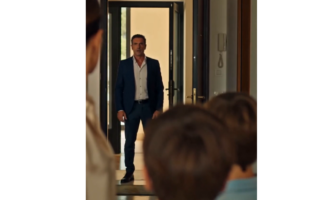
In the background, near the entrance, a figure.
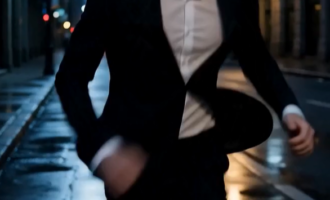
A man entered unnoticed, like a shadow slipping between two heartbeats. A millionaire, well-dressed, a weighty and controlled presence. He stopped by the door and didn’t take a step. The camera never shows his face. Never.
We see only his posture.
Motionless.
Behind the wife.
In the shadows.
He doesn’t speak. He doesn’t move. Yet, we feel his power in the air, like a threat or a judgment. His mere presence changes everything: it’s no longer just an argument, no longer just a humiliation. It’s a scene where someone is watching… and where the slightest movement could trigger the irreparable.
The wife, for her part, continues to wear her coldness like a crown.
The old woman lowers her head slightly, as if protecting herself. Her gaze lingers for a moment on something invisible—a memory, a face, a past that is kept hidden. Perhaps her son. Perhaps an old promise. Perhaps the day she sacrificed everything so that someone else could live a better life than she did.
And now, she is told that she is in the way.
That she must disappear.
In this perfect living room, it is poverty that is shocking. It is old age that is unsettling. It is tenderness that no longer has a place.
But the most disturbing thing… is not what is said.
It is what is left unsaid.
Because this man, near the door, remains silent. And this silence has an intention. The viewer doesn’t know if he has come to protect, to punish, to reveal, or to destroy.
He is there like a secret.
Like a truth about to fall.
Like a destiny holding its breath.
The camera lingers on the old woman’s hands. On her damaged fingers. On the way she clutches her bag—not out of fear of being robbed, but as if it were the last thing she still possessed.
We sense that something is approaching.
A gesture. A word. A glance.
And yet… nothing.
The tension mounts, slowly, unbearably. Each second prolongs the suspense. The viewer waits for the man to take a step. To speak. To reveal why he is there. To say what he knows. To utter the word that will shatter the entire house.
But the scene chooses the most powerful cruelty: waiting.
The truth lies in the shadows.
And the shadows do not turn back.
The final image offers no answers—only questions.
Who is this man, really?
Why did he enter unseen?
What does he know about this woman, this couple, this son we never see?
Did he come to save someone… or to finish something?
Then, suddenly, blackness.
Not a blackness that ends. A blackness that opens.
A blackness that leaves the heart hanging, as if the house itself had stopped breathing.
An open ending. Total intrigue.
And a feeling that lingers long after: in the wealthiest homes, there are sometimes secrets poorer than poverty… and silences more violent than screams.